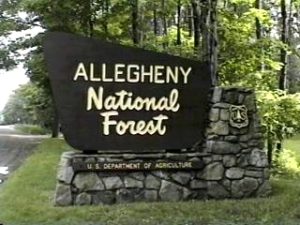
 Multiple-Use Management is the basis and original intent of establishment of the Allegheny National Forest in 1923. The ANF is the only national forest in Pennsylvania. Gifford Pinchot, a Pennsylvanian, is called the “Father of American Forestry” and was the first head of the U.S. Forest Service under the Department of Agriculture.
The “Organic Act” of 1897 (Sundry Civil Appropriations Act of 1897) was the first legislation concerning the management, protection and care of America’s forest reserves. It specifically stated that the criteria for new forest reserve designations were timber production, watershed protection and forest protection.
The Allegheny is approximately 517,000 acres within four counties of northwestern Pennsylvania (Elk, Forest, McKean and Warren). About 463,000 acres are forested, 42,000 are non-forest, and 11,000 are water. These acres are managed for sustainable yield timber production, water quality improvement, wildlife habitat, forestry research, Wilderness protection, varied recreation opportunities, mineral and energy production.
Timber harvest not only provides American and foreign markets with high quality hardwoods, but is a tool to improve the health and ecological diversity of the ANF. “Final Harvests” open the forest to benefit the next generation of trees, while producing the highest value timber. This (and other vegetation management activities) provides jobs for local workers and materials for the region’s wood products industry. Sale of the timber contributes to local communities through timber receipt funds, 25% of which goes to local school districts and municipalities. The remainder is directed back into management of the ANF.
Because oil production appeared to be substantially depleted by the time the ANF was established in 1923, the subsurface mineral rights were not acquired by the federal government. Today, 93% of the mineral rights on the ANF are still in private ownership and approximately 8,000 wells are active. The benefits to the local economy are not estimated by the ANF, but likely fall in the millions each year.
Recreation on the ANF is a significant attraction for the local tourism industry, resulting in revenues for businesses, wages for employees of those businesses, and tax revenues for local and state government. A wide variety of 4-season recreation opportunities are available on the ANF, including both motorized and non-motorized trails, and new initiatives to build use by rock climbing/bouldering and fat tire biking use on the forest.